

Pipe Supports and Corrosion Prevention
ESI offers composite and metal pipe supports: wear pads, flat plates, U-bolts, clamps, pipe shoes, cradles, slide plates, hangers and fabricated supports. These products eliminate metal-to-metal contact at pipe support points, where corrosion most often starts.
The Global Cost of Corrosion
- NACE International’s IMPACT study (2016) estimated the global cost of corrosion at US$2.5 trillion a year, about 3.4% of global GDP.
- Proven corrosion control practices could save 15–35% of that cost, or US$375–875 billion a year.
- The U.S. Cost of Corrosion study (FHWA/NACE, 2002) estimated annual direct costs in the United States at $276 billion.
- According to a NACE (now AMPP) study, corrosion costs the oil and gas production industry an estimated $1.372 billion a year: $589 million for surface pipelines and facilities, $463 million for downhole tubing, and $320 million in corrosion-related capital expenditures.
Why Pipe Supports Are a Corrosion Hot Spot
- A technical paper on corrosion at pipe supports (Britton, 2002) reports that, statistically, corrosion at pipe supports is the most common cause of external piping corrosion failure on offshore facilities.
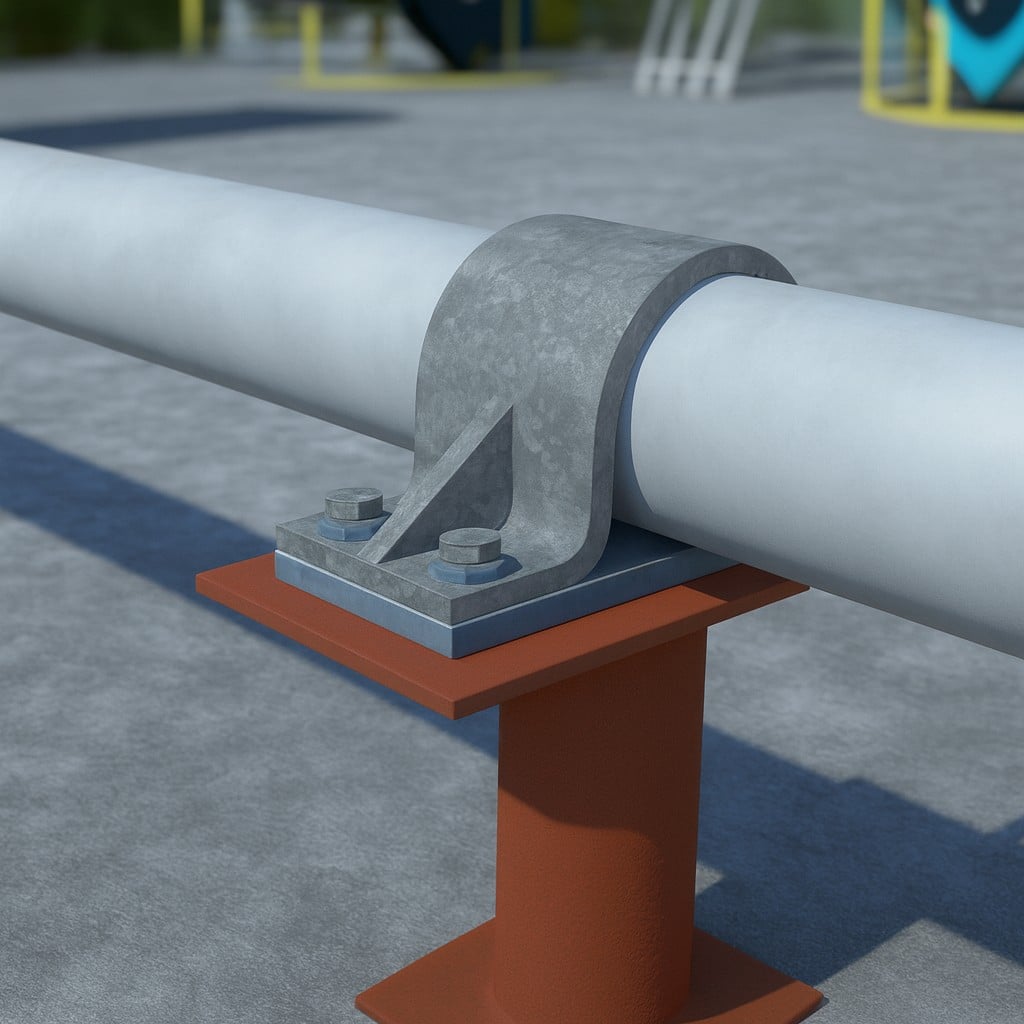
- Where the pipe rests on a support, a crevice forms that traps water against the pipe surface.
- Coatings designed for open-air exposure break down under constant wetting and pipe movement.
- Once the steel is exposed, crevice corrosion can accelerate by an order of magnitude.
Failures Caused by Corrosion
Guadalajara, Mexico (April 22, 1992)
New zinc-coated water pipes installed next to a steel gasoline pipeline caused an electrolytic reaction that corroded the steel. Gasoline leaked into the sewer system, and a series of explosions destroyed about 5 miles (8 km) of streets. The official death toll was 206, and about 15,000 people were left homeless.
Carlsbad, New Mexico (August 19, 2000)
A 30-inch natural gas pipeline ruptured and killed 12 people camping nearby. The NTSB found that severe internal corrosion had reduced the pipe wall until it could no longer contain the pressure.
Prudhoe Bay, Alaska (March 2, 2006)
Internal corrosion caused a 1/4-inch hole in a 34-inch transit line, releasing 212,252 gallons (5,054 barrels) of crude oil. In August 2006, pipelines carrying about 400,000 barrels a day, roughly half of the field’s output, were shut down. Penalties included a $20 million criminal fine and a $25 million civil penalty.
Marshall, Michigan (July 25, 2010)
A 30-inch crude oil pipeline ruptured and released more than 1 million gallons into the Kalamazoo River. The NTSB cited corrosion fatigue cracks under the pipeline’s disbonded coating. Cleanup costs reached $1.21 billion by November 2014.
Richmond, California (August 6, 2012)
An 8-inch refinery pipe ruptured from sulfidation corrosion, causing a fire. More than 15,000 residents sought medical treatment, according to the U.S. Chemical Safety Board.
Santa Barbara County, California (May 19, 2015)
External corrosion ruptured a crude oil pipeline and released 123,228 gallons (2,934 barrels), part of which reached the Pacific Ocean. PHMSA found that the operator failed to protect the line from corrosion and failed to detect the rupture.
Prevention Costs Less Than Failure
Industry studies estimate that corrosion control can save 15–35% of corrosion costs. At pipe supports, failure starts where metal meets metal and water is trapped against the pipe. The products below are designed to eliminate that contact.
Sources: NACE IMPACT study (2016) | AMPP: Cost of Corrosion Study | Corrosion at Pipe Supports (Britton, 2002) | NTSB: Carlsbad pipeline rupture report | NTSB: Enbridge Line 6B report | U.S. Chemical Safety Board: Chevron Richmond report | PHMSA: Plains pipeline failure investigation | Prudhoe Bay oil spill | 1992 Guadalajara explosions
Pipe Support Specifications
General Specifications: Composite Pipe Supports
| Products | Wear pads, flat plates, coated U-bolts, VibraTek clamps, CryoTek and ProTek pipe shoes, AeroTek cradles, slide plates |
|---|---|
| Composite Material | Fiber-reinforced vinyl ester (VEFR) composite: wear pads, flat plates, ProTek pipe shoes, AeroTek cradles |
| Temperature Range | Composites −320°F to +400°F (−196°C to 204°C); VibraTek −60°F to 450°F (−51°C to 232°C); ProTek U-bolt coating −67°F to 230°F (−55°C to 110°C) |
| Installation | No welding or hot work permits for wear pads, flat plates, pipe shoes, cradles and clamps; epoxy or stainless steel bands depending on product |
| Custom | Custom sizes available across the range |
| Data Sheets | Wear Pad | Flat Plate | U-Bolt | CryoTek Pipe Shoe | ProTek Pipe Shoe |
General Specifications: Metal Pipe Supports
| Products | T-style pipe shoes, pipe clamps and hangers, structural attachments, rods and accessories, hold down straps, fabricated supports |
|---|---|
| Materials | Carbon steel (A36 for T-style shoes); 304 or 316 stainless steel |
| Finishes | Plain, hot-dip galvanized, painted, Xylan or Teflon coated, depending on product |
| Standards | MSS SP-58/69 (hangers, structural attachments, rods and accessories) |
| Custom | Fabricated to customer drawings |
Wear Pads and Flat Plates
ProTek Composite Wear Pads
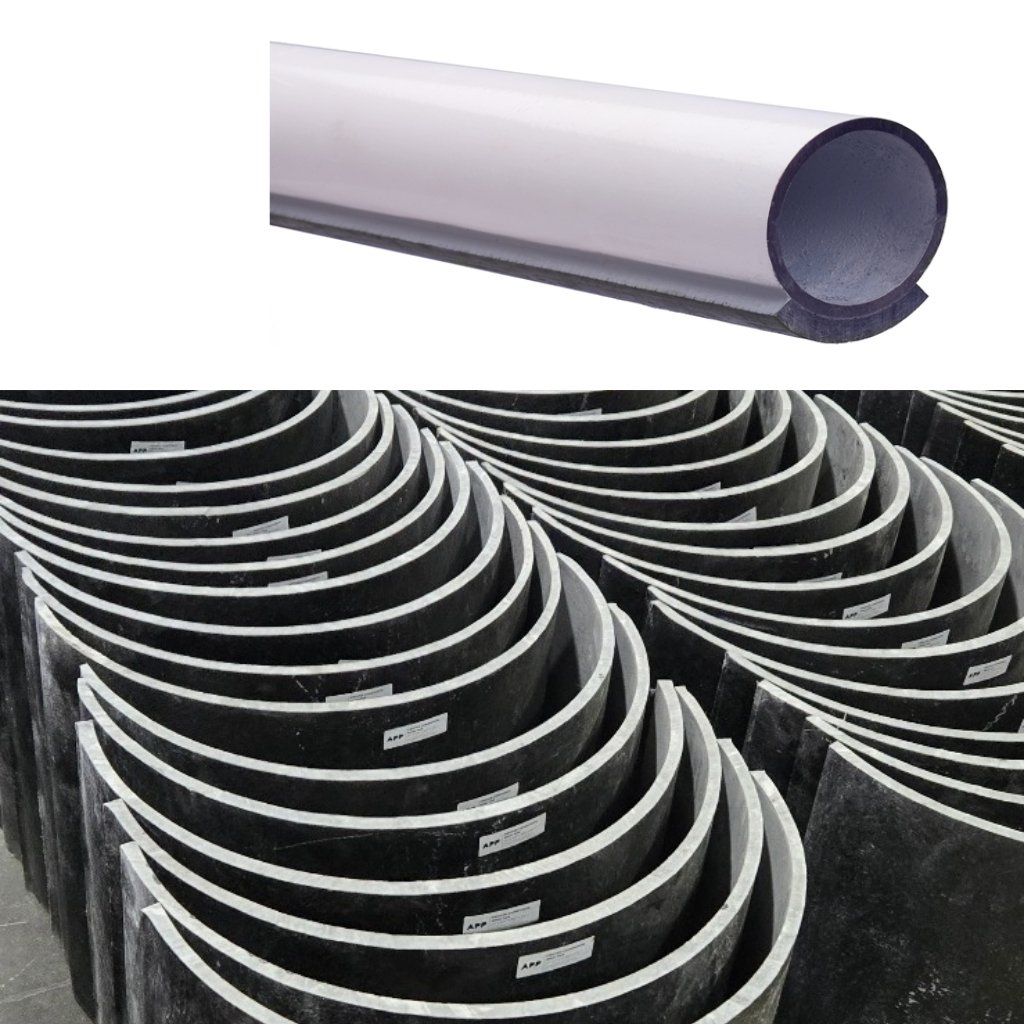
ProTek Composite Wear Pads prevent metal-to-metal contact by isolating the pipe from I-beams, guides and concrete supports. The wear pad ID matches the pipe OD and is pre-roughened for epoxy-to-wear-pad bonding strength verified by ASTM D5528-01. No welding, hot work permits or highly skilled personnel are required.
| Composition | Fiber-reinforced vinyl ester (VEFR/EFR) composite |
|---|---|
| Max Compressive Strength | 53,000 lb (24,040 kg), ASTM E8 |
| Temperature Range | −320°F to +400°F (−196°C to 204°C) |
| Installation | EX-100 epoxy system |
| Required Accessories | Epoxy, static mixing nozzle, manual dual-component applicator |
| Lengths | 12″ or 14″ (305 or 356 mm) |
| Custom | Any thickness, degree of coverage and length |
| Insulated Pipe Option | AeroTek Cradle |
Standard wear pad sizes (more sizes available on request):
| Pipe Size (NPS) | Thickness | Coverage | Length |
|---|---|---|---|
| 1/4″ (DN 8) | 1/4″ (6.4 mm) | 90° | 12″ (305 mm) |
| 3/4″ (DN 20) | 1/4″ (6.4 mm) | 90° | 12″ (305 mm) |
| 1″ (DN 25) | 1/4″ (6.4 mm) | 90° | 12″ (305 mm) |
| 1-1/2″ (DN 40) | 1/4″ (6.4 mm) | 90° | 12″ (305 mm) |
| 2″ (DN 50) | 1/4″ (6.4 mm) | 90° | 12″ (305 mm) |
| 2-1/2″ (DN 65) | 1/4″ (6.4 mm) | 90° | 12″ (305 mm) |
| 3″ (DN 80) | 1/4″ (6.4 mm) | 90° | 12″ (305 mm) |
| 4″ (DN 100) | 1/4″ (6.4 mm) | 90° | 12″ (305 mm) |
| 6″ (DN 150) | 1/4″ (6.4 mm) | 60° | 12″ (305 mm) |
| 8″ (DN 200) | 1/4″ (6.4 mm) | 60° | 12″ (305 mm) |
| 10″ (DN 250) | 1/4″ (6.4 mm) | 60° | 12″ (305 mm) |
| 12″ (DN 300) | 1/4″ (6.4 mm) | 30° | 12″ (305 mm) |
| 14″ (DN 350) | 1/4″ (6.4 mm) | 30° | 12″ (305 mm) |
| 16″ (DN 400) | 1/4″ (6.4 mm) | 30° | 12″ (305 mm) |
| 18″ (DN 450) | 1/4″ (6.4 mm) | 30° | 12″ (305 mm) |
| 20″ (DN 500) | 1/4″ (6.4 mm) | 30° | 12″ (305 mm) |
| 22″ (DN 550) | 1/4″ (6.4 mm) | 30° | 12″ (305 mm) |
| 24″ (DN 600) | 3/8″ (9.5 mm) | 30° | 12″ (305 mm) |
| 30″ (DN 750) | 3/8″ (9.5 mm) | 30° | 12″ (305 mm) |
| 36″ (DN 900) | 3/8″ (9.5 mm) | 30° | 12″ (305 mm) |
ProTek Flat Plate
ProTek Flat Plate is made from the same composite as the wear pads, for flat surfaces. It serves as a non-metallic bearing surface in corrosion-prone areas; mated to a PTFE sheet, it acts as a slide plate, and it can be used as a shim to correct height inconsistencies. It installs in minutes, with no welding or hot work permits.
| Max Compressive Strength | 53,000 lb (24,040 kg), ASTM E8 |
|---|---|
| Temperature Range | −320°F to +400°F (−196°C to 204°C) |
| Installation | EX-100 epoxy |
| Required Accessories | Epoxy, static mixing nozzle, manual dual-component applicator |
| Custom Sizes | Up to 3 ft wide × 10 ft long (0.9 × 3.0 m) |
| Thicknesses | 1/8″, 1/4″ and 3/8″ (3.2, 6.4 and 9.5 mm); setup fee may apply |
ProTek Coated U-Bolts
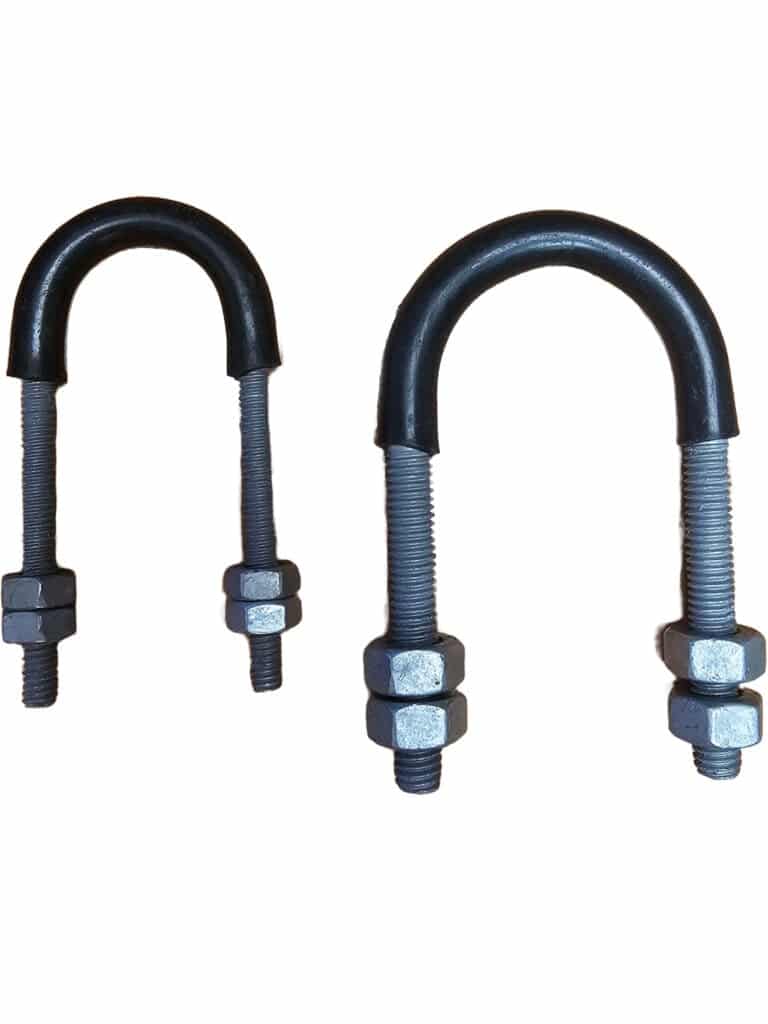
Standard U-bolts are built to Grinnell Figure 137 specifications and hot-dip galvanized, with nuts included. ProTek U-bolts add a polymer coating that restrains the pipe while preventing metal-to-metal contact and abrasion from pipe movement. The coating has a low coefficient of friction to allow pipe movement, and the U-bolts can be used on any type of pipe.
| Composition | Carbon steel or stainless steel |
|---|---|
| Coating Tensile Strength | 1,500 psi (103 bar), ASTM D412 |
| Temperature Range | −67°F to 230°F (−55°C to 110°C) |
| Installation | Four heavy hex nuts |
| Accessories | ProTek Rod; ProTek Package (with ProTek Wear Pad and ProTek Flat Plate) |
| Pipe Sizes | 1/2″ to 36″ (DN 15 to 900) |
| Buffer Pad Options | ProTek Flat Plate, ProTek Rod, neoprene or PTFE |
| Custom | Custom sizes (rod thickness, width, length, thread length) and finishes: carbon steel, stainless steel, Xylan, Teflon or cadmium coated |
VibraTek Clamps
VibraTek Hold Down Clamps absorb vibration from compressors and reciprocating equipment through a VibraTek liner with fiber-backed Teflon (HB-Teflon) for a low coefficient of friction. Liners are molded to the clamp inside diameter for consistent thickness and a secure bond. VibraTek is hydrophobic and non-porous, so it does not hold moisture, and HB-Teflon does not delaminate because of the fibers infused during manufacturing.
| Composition | VibraTek liner and HB-Teflon |
|---|---|
| Max Compressive Strength | 20,000 lb (9,072 kg) |
| Temperature Range | −60°F to 450°F (−51°C to 232°C) |
| Installation | Field install |
| Required Accessories | None |
| Liner Options | VibraTek, urethane, neoprene or sodium-etched Teflon |
| Custom | Fabricated to your dimensions |
| Applications | Refineries, all piping systems, high-vibration systems |
Composite Pipe Shoes (CryoTek and ProTek)
CryoTek Pipe Shoes
The CryoTek Pipe Shoe is a non-metallic pipe support for extreme temperatures, from −320°F to +400°F (−196°C to 204°C), for elevated and cryogenic piping in gas liquefaction, LNG terminals and carriers, and ethylene plants.
- Composite technology does not promote temperature transfer, preventing ice formation and fluctuation in system temperature
- Eliminates the steel shoe multi-layer insulation requirement, which can delaminate over time
- UV-resistant resin that does not support combustion; can be combined with an intumescent coating to resist 2,000°F (1,093°C) for up to two hours
- Installs in a fraction of the time of pre-insulated metallic supports
- Lightweight; can be installed and transported without heavy-lift equipment
- Encapsulates the insulation used in cryogenic piping systems
| Composition | Monolithic unit molded under vacuum from continuous strand glass mat in a hybrid thermosetting resin, around a core of low-density polyurethane foam insulation |
|---|---|
| Max Compressive Strength | 27,500 psi (1,896 bar) |
| Temperature Range | −320°F to +400°F (−196°C to 204°C) |
| Installation | EX-100 epoxy system, 3/4″ (19 mm) steel banding |
| Required Accessories | Epoxy, static mixing nozzle, manual dual-component applicator, steel bands, banding clips and banding tool |
| Custom | Any diameter, width, height and length |
CryoTek Pipe Shoe Data Sheet (PDF)
ProTek Composite Pipe Shoes
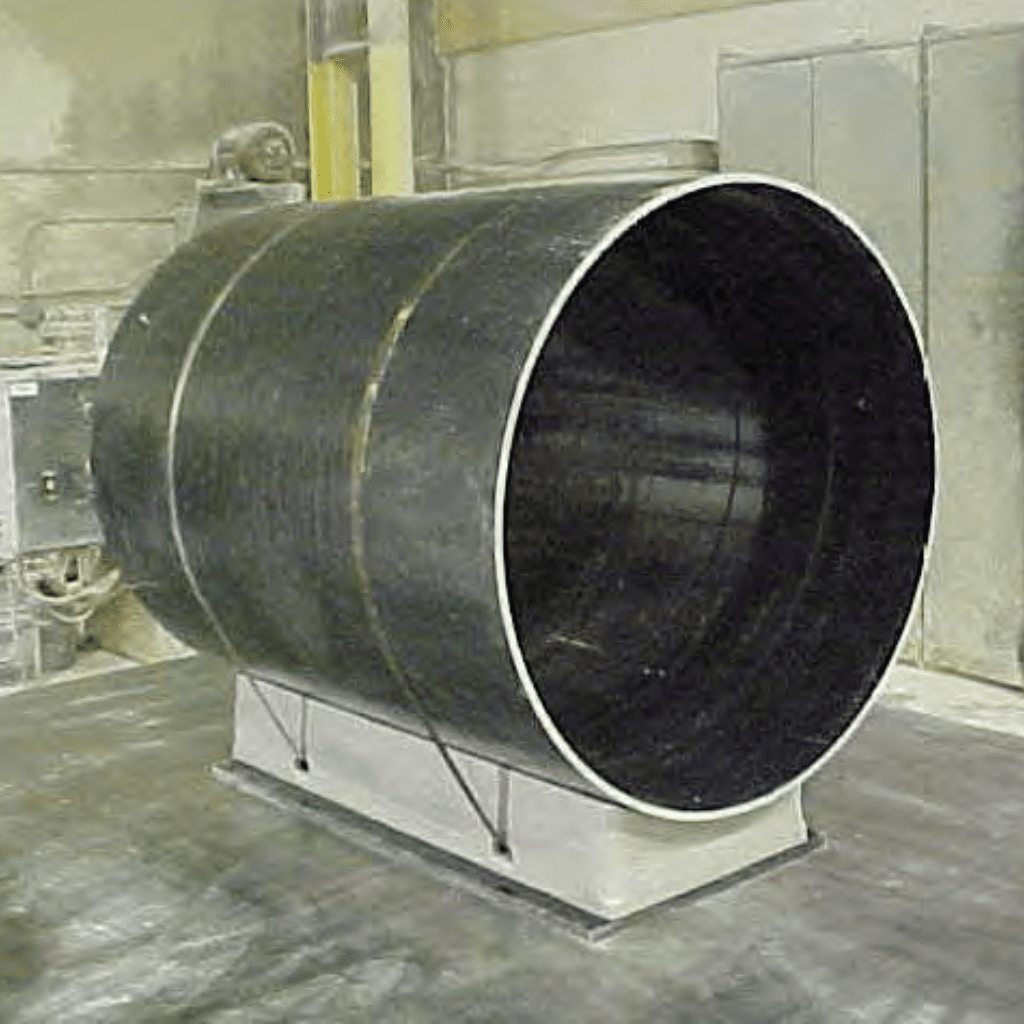
The ProTek Composite Pipe Shoe is a UV-resistant, non-metallic support for elevated or insulated piping in plants and refineries, onshore and offshore. It is resistant to chemical attack, and its non-conductive composite does not promote heat transfer. It is installed with two stainless steel bands, with no welding and no metal-to-metal contact; standard installation time is 30 to 45 minutes per shoe.
| Composition | Fiber-reinforced vinyl ester (VEFR) composite |
|---|---|
| Max Compressive Strength | 150,000 lb (68,039 kg) |
| Temperature Range | −320°F to +400°F (−196°C to 204°C) |
| Installation | Pipe fastened to the shoe with stainless steel bands |
| Required Accessories | Steel bands, banding clips, banding tool, silicone |
| Fire Protection Option | Intumescent coating for a 2-hour rating at 2,000°F (1,093°C) |
| Custom | Any pipe diameter, height and length |
Standard dimensions:
| Shoe (L × W × H) | Pipe Size |
|---|---|
| 12″ × 4″ × 4″ (305 × 102 × 102 mm) | 1/2″ to 3″ |
| 14″ × 5-1/2″ × 4″ (356 × 140 × 102 mm) | 4″ to 18″ |
| 18″ × 5-1/2″ × 6″ (457 × 140 × 152 mm) | 4″ to 18″ |
AeroTek Cradles
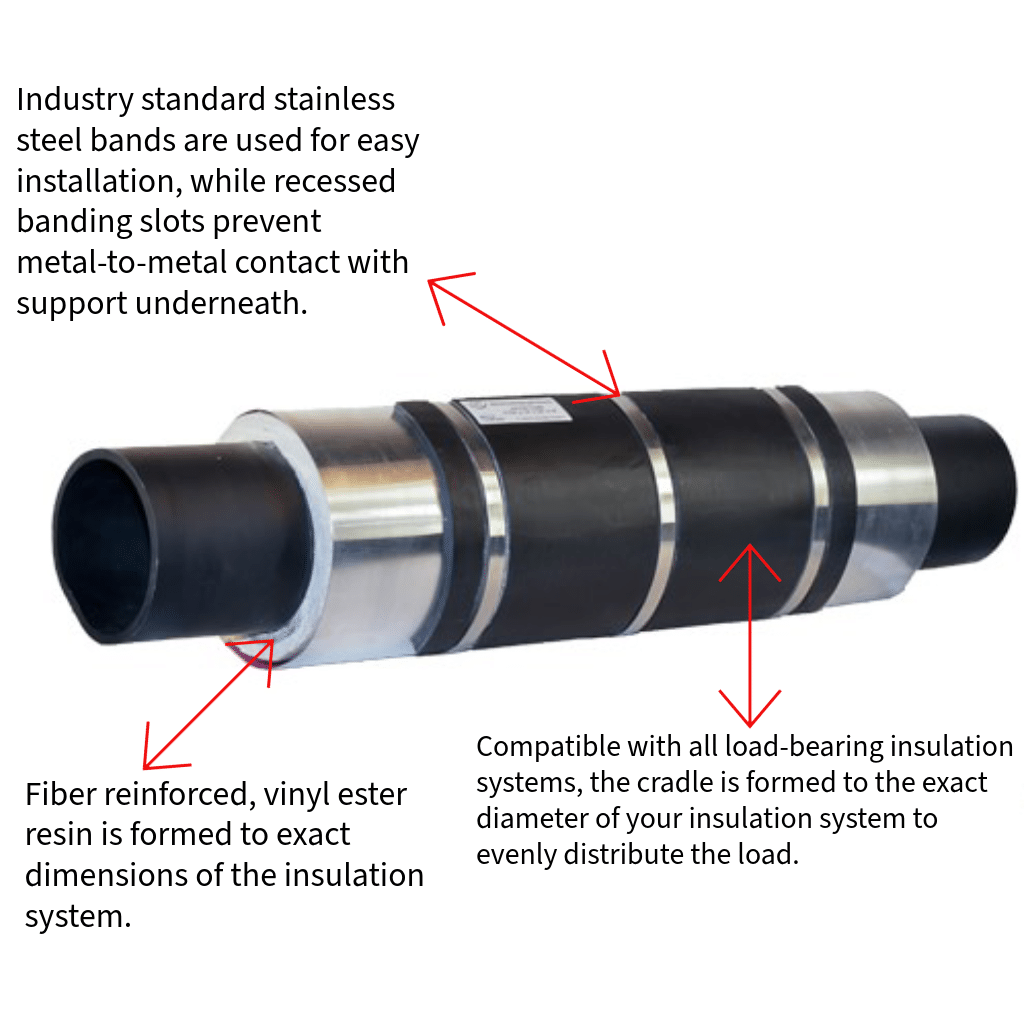
The AeroTek Cradle protects pipe insulation from abrasion at support points in hot and cold service. It is molded from fiber-reinforced vinyl ester resin to fit the insulation system and is fastened at support locations with stainless steel bands, recessed into grooves so the bands do not contact the support.
- Eliminates the need for pre-insulated pipe supports
- Does not require a break in insulation like welded or clamp-on supports
- Compatible with any load-bearing insulation
- Eliminates corrosion issues associated with metallic supports
- Lightweight for ease of installation
| Composition | Fiber-reinforced vinyl ester (VEFR) composite |
|---|---|
| Temperature Range | −320°F to +400°F (−196°C to 204°C) |
| Installation | Field install, no welding; stainless steel bands in recessed slots |
| Required Accessories | Banding clips and fasteners |
| Maximum Load | Depends on the load-bearing insulation used |
| Sizes | Standard sizes on request; fabricated to your dimensions |
Slide Plates
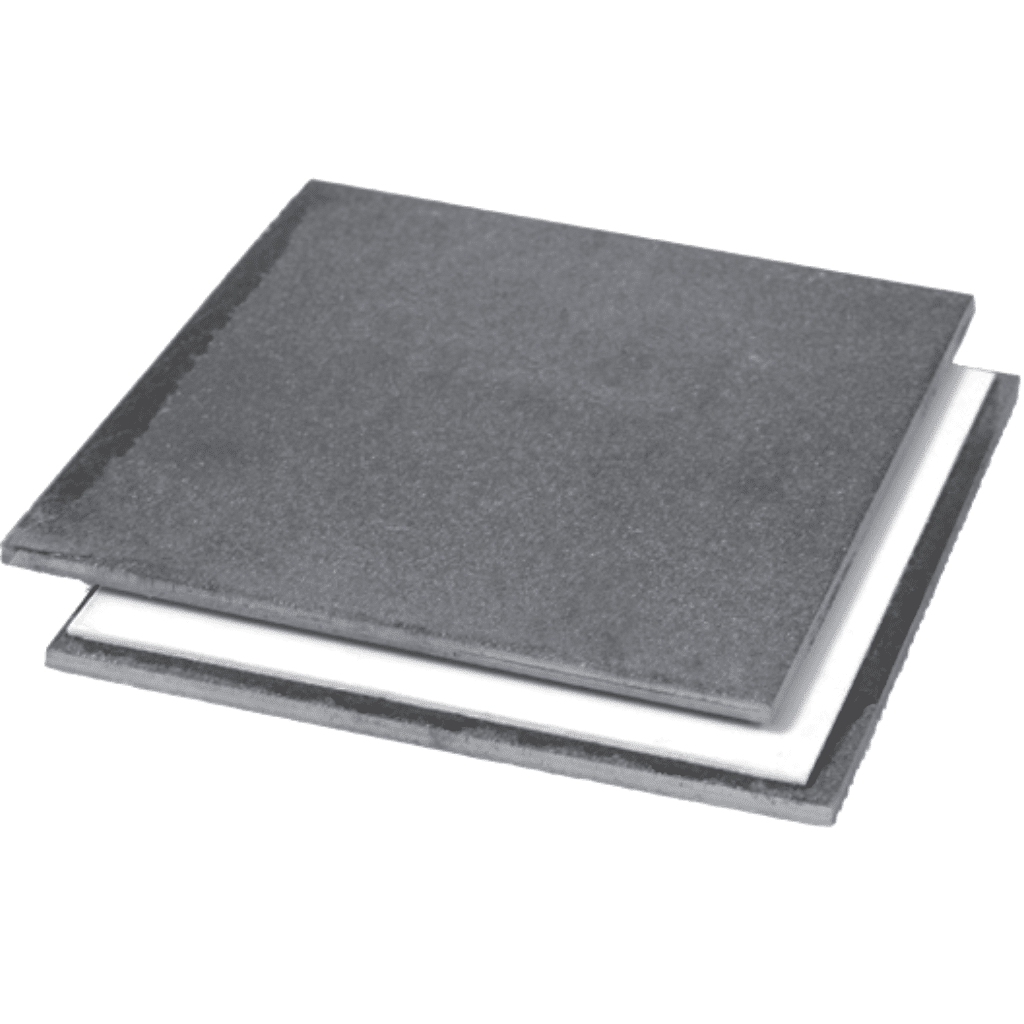
ProTek Slide Plates minimize friction and wear at expansion and contraction joints, supporting heavy piping, equipment, bridges and structural members. The metal backing and PTFE combination provides support with a low-friction surface; sodium-etched PTFE is used for adhesion and to prevent delamination.
| Bearing Surface | Sodium-etched PTFE, 3/32″ (2.4 mm) thick, bonded to 10-gauge carbon steel |
|---|---|
| Installation | Welded to steel components |
| Custom | Backing plates and slide surfaces in different thicknesses and materials (stainless steel, graphite, FRP) |
T-Style Pipe Shoes
T-style pipe shoes are made from solid A36 carbon steel structural beam (wide-flange beams or plates), in different structural tee sizes.
| Material | A36 carbon steel; 304 or 316 stainless steel available |
|---|---|
| Finishes | Plain carbon steel, hot-dip galvanized (HDG) or painted |
| Styles | Weld-on (wide-flange beam or plates); clamp-on (base tee with two clamps); U-bolt-on (base tee with saddle and two U-bolts); heavy-duty version of each style with added gussets |
| Options | Height, length, banding slots, slide plates, gussets, liners for clamps and U-bolts |
| Load Capacity | Depends on design and application |
Pipe Hangers and Attachments
Pipe Clamps and Hangers
Pipe attachments connect to threaded rods in hanger systems to hold the weight of the pipe and suspend piping runs. Available in carbon steel, stainless steel and hot-dip galvanized (HDG), to MSS SP-58/69.
| Product | Figure | Pipe Size |
|---|---|---|
| Medium pipe clamps | Fig. 212 | 1/2″ to 30″ (DN 15 to 750) |
| Heavy pipe clamps | Fig. 216 | 3″ to 42″ (DN 80 to 1050) |
| Adjustable clevis hangers | Fig. 260 | 1/2″ to 30″ (DN 15 to 750) |
| Double bolt pipe clamps | Fig. 295 | 3/4″ to 36″ (DN 20 to 900) |
| Adjustable steel yoke pipe rolls | Fig. 181 | — |
Structural Attachments
Structural attachments weld, bolt or clamp hanger systems to beams and structures, to MSS SP-58/69.
| Product | Figure | Size Range |
|---|---|---|
| Short structural welding lugs | Fig. 55 | 1/2″ to 3-3/4″ (12.7 to 95.3 mm) |
| Welding lugs for elbows | Fig. 53-SD | — |
| Welded beam attachments | Fig. 66 | 3/8″ to 3-1/2″ (9.5 to 88.9 mm) |
| Steel washer plates | Fig. 60 | 3/8″ to 3-3/4″ (9.5 to 95.3 mm) |
| Standard duty beam clamps | Fig. 133 | 4″ to 12″ (102 to 305 mm) |
| Universal forged steel beam clamps | Fig. 228 | Rod 5/8″ to 1-1/2″ (15.9 to 38.1 mm) |
| Standard universal C-type clamps | Fig. 92 | Rod 3/8″ to 1/2″ (9.5 to 12.7 mm) |
Rods and Accessories
Rods and accessories for pipe hanger assemblies, to MSS SP-58/69.
| Product | Figure | Size Range |
|---|---|---|
| Continuous threaded rod | Fig. 146 | 1/4″ to 1-1/2″ (6.4 to 38.1 mm) |
| Weldless eye nuts | Fig. 290 | 3/8″ to 2-1/2″ (9.5 to 63.5 mm) |
| Forged steel clevises | Fig. 299 | 3/8″ to 4″ (9.5 to 101.6 mm) |
| Turnbuckles | Fig. 230 | 3/8″ to 2-1/2″ (9.5 to 63.5 mm) |
| Welded eye rods | Fig. 278 | 3/8″ to 2-1/2″ (9.5 to 63.5 mm) |
Hold Down Straps
Lined hold down straps are a medium restraint that protects the coating of uninsulated carbon steel pipe while holding the pipe in place. The liner is molded directly into the strap inside diameter, not bonded, so it does not delaminate, and it includes UV inhibitors.
| Base Material | Hot-dip galvanized carbon steel |
|---|---|
| Liner Options | VibraTek, neoprene, PTFE or Fabreeka® |
| Configurations | Half-threaded or full-threaded |
| Finishes | Galvanized, Xylan coated or Teflon coated |
| Temperature Range | Depends on the liner material |
| Installation | Field install; no accessories required |
| Custom | Custom sizes and configurations on request |
| Pipe Size | Strap Thickness | Liner Thickness |
|---|---|---|
| 1″ to 8″ (DN 25 to 200) | 1/4″ (6.4 mm) | 1/4″ (6.4 mm) |
| 10″ to 14″ (DN 250 to 350) | 3/8″ (9.5 mm) | 1/4″ (6.4 mm) |
| 16″ to 24″ (DN 400 to 600) | 1/2″ (12.7 mm) | 1/4″ (6.4 mm) |
Fabricated Supports
| Product | Function |
|---|---|
| Pipe stanchions | Rigid support that prevents movement in any direction (up, down or sideways) without allowing rotation |
| Base supports / trunnions | Support stand on sections of pipe, or a pipe branch added to a straight pipe, elbow or transition |
| Pipe stops | Restrict movement in two directions, protecting pipe from bending and buckling |
| Pipe guides | Attached to a stationary structure; guide the pipe while allowing slight pipe movement |
| Structural supports | Tee posts, knee braces and trapeze supports for bracing and arranging piping in pipe racks, generally custom-made for field installation |
| Custom supports | Made to spec from customer needs and drawings |
Frequently Asked Questions
Corrosion Prevention at Pipe Supports
How much does corrosion cost worldwide?
NACE International’s IMPACT study (2016) estimated the global cost of corrosion at US$2.5 trillion a year, about 3.4% of global GDP, and estimated that proven corrosion control practices could save 15–35% of that cost.
Why do pipes corrode at pipe supports?
Where the pipe rests on a support, a crevice forms that traps water against the pipe surface. Coatings break down under constant wetting and pipe movement, and once the steel is exposed, crevice corrosion can accelerate by an order of magnitude.
How do pipe supports help prevent corrosion?
Wear pads, flat plates, coated U-bolts, lined clamps and straps, and composite pipe shoes eliminate metal-to-metal contact at the support point.
Composite Pipe Supports
What temperature range do the composite supports cover?
Wear pads, flat plates, CryoTek and ProTek pipe shoes and AeroTek cradles are rated −320°F to +400°F (−196°C to 204°C). VibraTek clamps are rated −60°F to 450°F (−51°C to 232°C).
Do wear pads require welding?
No. ProTek wear pads are installed with the EX-100 epoxy system, with no welding, hot work permits or highly skilled personnel required.
What sizes do ProTek wear pads come in?
Standard sizes cover pipe from 1/4″ to 36″ in 12″ (305 mm) lengths, with 1/4″ or 3/8″ (6.4 or 9.5 mm) thickness. Custom thickness, coverage and length are available.
What is the difference between CryoTek and ProTek pipe shoes?
The CryoTek pipe shoe has a polyurethane foam insulation core and is designed for cryogenic piping, with a maximum compressive strength of 27,500 psi (1,896 bar). The ProTek composite pipe shoe is a solid composite support for elevated or insulated piping, with a maximum compressive strength of 150,000 lb (68,039 kg). Both are rated −320°F to +400°F (−196°C to 204°C).
How do VibraTek clamps handle vibration?
The VibraTek liner absorbs vibration from compressors and reciprocating equipment, and fiber-backed HB-Teflon in the liner provides a low coefficient of friction.
Metal Pipe Supports
What materials and finishes are available?
Carbon steel (A36 for T-style shoes) and 304 or 316 stainless steel, in plain, hot-dip galvanized, painted, Xylan or Teflon coated finishes depending on the product.
What standard do the pipe hangers and attachments follow?
MSS SP-58/69.
What T-style pipe shoe styles are available?
Weld-on, clamp-on and U-bolt-on, each also available as a heavy-duty version with added gussets.
Can metal supports be made to drawings?
Yes. Stanchions, trunnions, pipe stops, guides, structural supports and custom supports are fabricated to customer drawings.
Ordering
How do I request a quote?
Use the Request A Quote button in the product section above, or contact Enerteq Solutions with the product, pipe size and quantity.
Custom Pipe Supports
Custom sizes are available across the range:
- Wear pads in any thickness, degree of coverage and length
- Flat plates up to 3 ft × 10 ft (0.9 × 3.0 m), 1/8″, 1/4″ or 3/8″ (3.2, 6.4 or 9.5 mm) thick
- U-bolts and hold down straps in custom sizes and finishes
- VibraTek clamps fabricated to your dimensions, with urethane, neoprene or sodium-etched Teflon liners
- Slide plates with stainless steel, graphite or FRP surfaces and custom backing plates
- Pipe shoes and cradles in any diameter, height and length
- Metal supports fabricated to customer drawings
Composite pipe shoes, FRP pipe supports and VibraTek clamps are also listed on the ESI pipe supports page from ESI Flange Spreader Rentals, Enerteq’s flange-tool division.